Thursday, June 6, 2013

Day 10: Compiègne

Today was a group field trip for all the Americans (from WHS, SHS, and MHS) to go to Compiègne, a  city of about 45,000 people on the Oise river in the heart of the Picardy region. Here's link to locate it on a map. The weather was beautiful and we, the Westmoore group, set off early from Montdidier.

Caroline and Valeria went to Amiens for the day to meet up with Sonia, one of the French students who came to Westmoore in October 2011. They would attend classes at her Career Technology high school and do some more shopping and exploring around Amiens:
 
This is the rest of our group in Montdidier at the train station preparing to board the train for Compiègne:


To help pass the time on the 30-minute trip to Compiègne, Madame Robillard returned to her favorite topic with Madame Worster: "Have you seen the horrible nail job I paid 45 euros for in Montdidier? Here, let me show you!" Madame Worster was a good sport about it all (for about 11.5 seconds).

Once we arrived in Compiègne, we went on a short walking tour and stopped on the bridge overlooking the Oise river. The bridge we were crossing was rebuilt after World War II. The bridge that had stood in its place was the bridge over which all of the French people passed who were sent to German concentration camps.

This is Genasee with a view of the Oise river and parts of the city of Compiègne behind her.

Katie and Carly ar standing at the commemorative sign which reads: "Remember! 48,000 French people deported towards the Nazi forced labor camps crossed on the bridge that stood at this point. This sad memory explains Katie's sad look. She agreed that we should not smile for such a sad picture.

This is the last vestige of what was once an tower of the royal castle which overlooked the Oise river in medieval times and served as part of the royal defenses of the city:


This plaque explains that St. Joan of Arc came to the help of the city of Compiègne in 1430 on the 23rd of May and engaged in a battle on that same day. She fell into the hands of the enemy during that battle at the walls of the city. The lord of the castle watched her from this tower as she was captured just across the river. St. Joan of Arc is quoted as having said: "Since God with help the city of Compiègne, I want to be there." So this is the city where Joan of Arc last fought and where she was captured. From here she was taken to the city of Rouen to be tried for witchcraft and it is there that she was burned at the stake. You can read more about Joan of Arc at this link.
Here is Allison at one of the tower's windows, perhaps the one from with the lord watched St. Joan of Arc being taken prisoner?

Our first place to visit was the Vivenel Museum. This collection was built by a wealthy French industrialist in the 20th century who built a magnificent collection of art from ancient times to the early 20th century. The entire collection was given as a gift to the city of Compiègne and the museum is in a beautiful home from the early 19th century.
Among the interesting site we saw at the Vivenel Musuem was the Egyptian mummy of a baby from the  5th century BCE.
Of course, Austin, Allison, and Katy had to ham it up for the camera when they saw the mummy!

Here are some other interesting art objects we saw at the Vivenel Museum:
This very old house, dating from the late Middle Ages, survived countless wars (including World Wars I & II) and stands today just across from the Vivenel Museum
Our next place to visit was the Church of St. Antoine:
This cathedral was build in the flamboyant gothic style and suffered some damage from wars, but it has been well-restored.
This is the very old baptismal font in the church. It is still used for baptisms.
There is a large basin under the brass covering

Michaela in front of an old door at the back of the church.
You really get a feeling for the age of the church when looking at the old, small doors there.
Allison kneeling in front of the Pietà in a decorated alcove in the corner at the back of the church.
While inside the church, Madame Robillard took a pause with the students and Madame Worster to explain the life and importance of St. Joan of Arc, the patron saint of France. Inside every French church there is a statue and memorial for St. Joan of Arc. Of course, the very next thing we came upon was this statue of St. Joan of Arc. There were also stained glass windows depicting her capture in Compiègne.
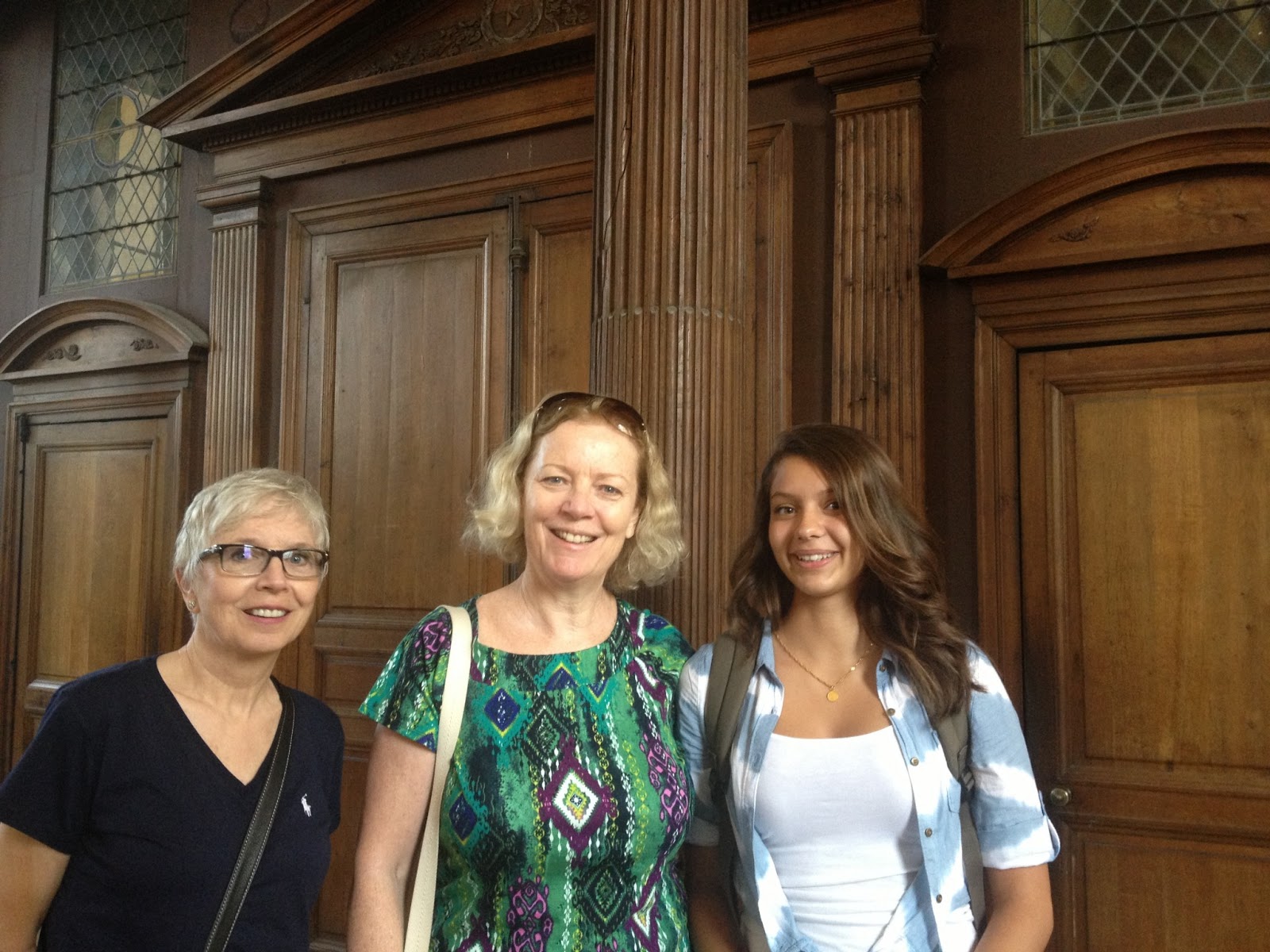
We met some lovely ladies from British Columbia, Canada in the church. Of course, they were thrilled to meet Chantal and to hear about our trip and our experiences in the May 20th tornado, which they had of course heard about.

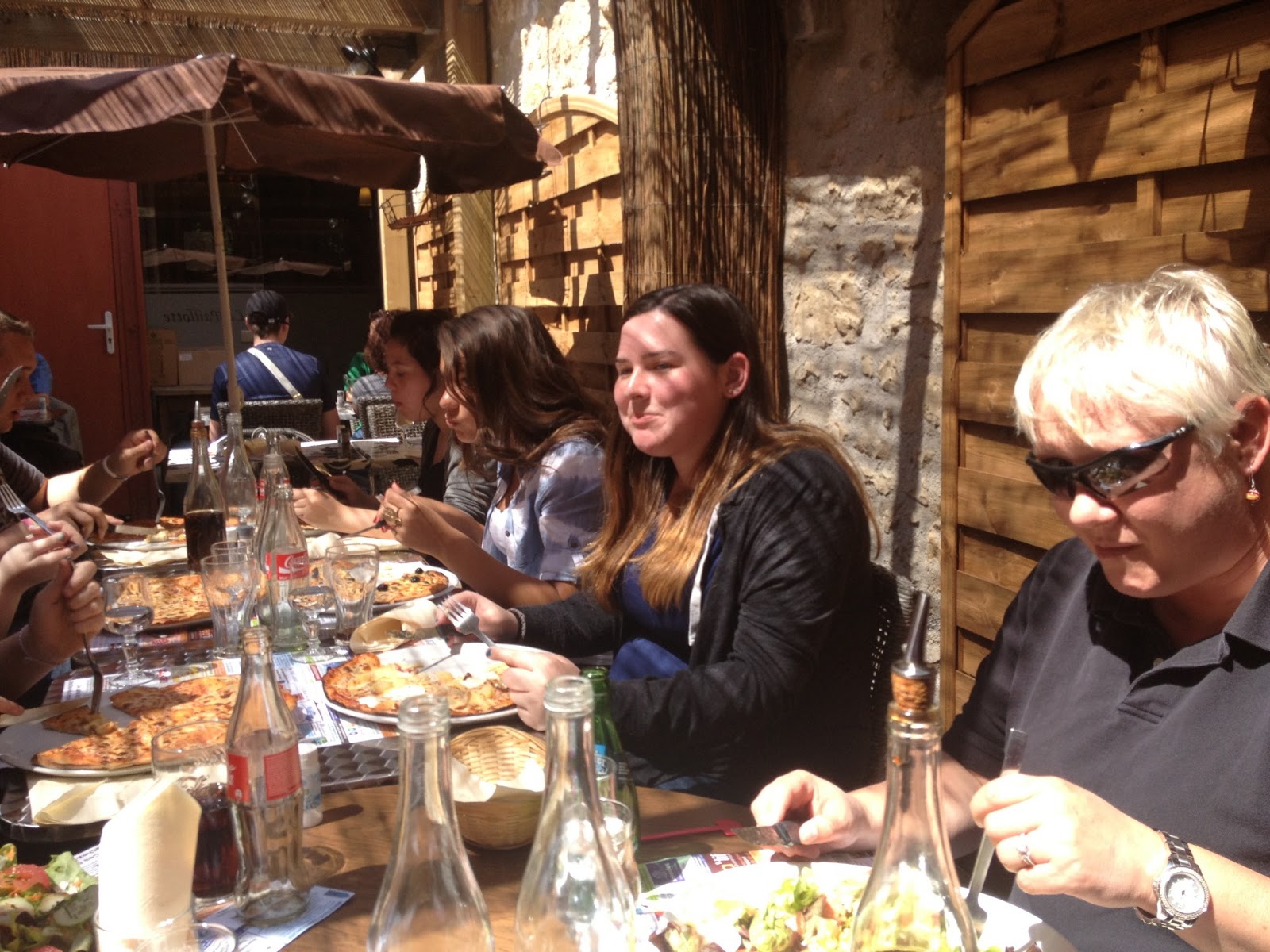
After leaving the Church of St. Antoine, we walked a bit further towards the center of town and had a free half hour to shop and people-watch. Then, we went to have pizza for lunch. We were seated on the veranda of the restaurant. As you can tell, it was sunny and Madame Worster had to get resourceful. The pizza and dessert were delicious!
We then went to the Château de Compiègne, also known as the Château impérial, which you can read about at this link.


The rooms were magnificent and we wandered with hand-held electronic guides so we could observe and listen at our leisure:

This was a type of billiards-meets-pinball game from the early 19th century:
Since it was Napoleon who renovated and returned glory to this castle, his 
Madame Robillard would love a pair of sandals just like Napoleon's:
The decorative arts all over the castle were quite impressive:

Our next stop was the Cloister Museum (le Musée du Cloître) where many medieval gravestones, statues, and other art objets are on display. Honestly, we were so tired and thirsty by the time we reached this museum, and the students had clearly had they fill of churches and museums, that we did nit stay long. But what we did see at this museum was interesting.
The museum is housed in a cloister that dates from the first millenium.
The top sign reads: "Site of the Abbey of St. Corneille founded by the Emperor Charles the Bald dedicated to the Holy Mary in the 9th century."
The bottom sign reads: "Here were crowned four Kings
Louis II in 877
Eude in 888
Louis V in 979
Hugue II in 1017
Here were buried three kings
879, 987, 1025
and one crown prince 1417"

There is also a very touching and sad story of the Carmelite nuns from Compiègne who were guillotined during the Terror in 1794, after the French Revolution.
You can read more at this link.

Michaela with the gravestones of a husband and wife from the 15th century in the Museum of the Cloister.

On our way back to the train station, we came upon the town hall of the city of Compiègne, which was built during the Renaissance:
Across from the town hall was a statue of the victorious St. Joan of Arc:

For a bit of modern culture here a two signs we came cross in Compiègne:
"There is no [specific] age for being oneself."
And in a bathroom: "Please leave this place as clean as you would like to find it upon entering. Thank you."

Wednesday, June 5, 2013

Day 9: The Art of Flags and Teacher Field Trip

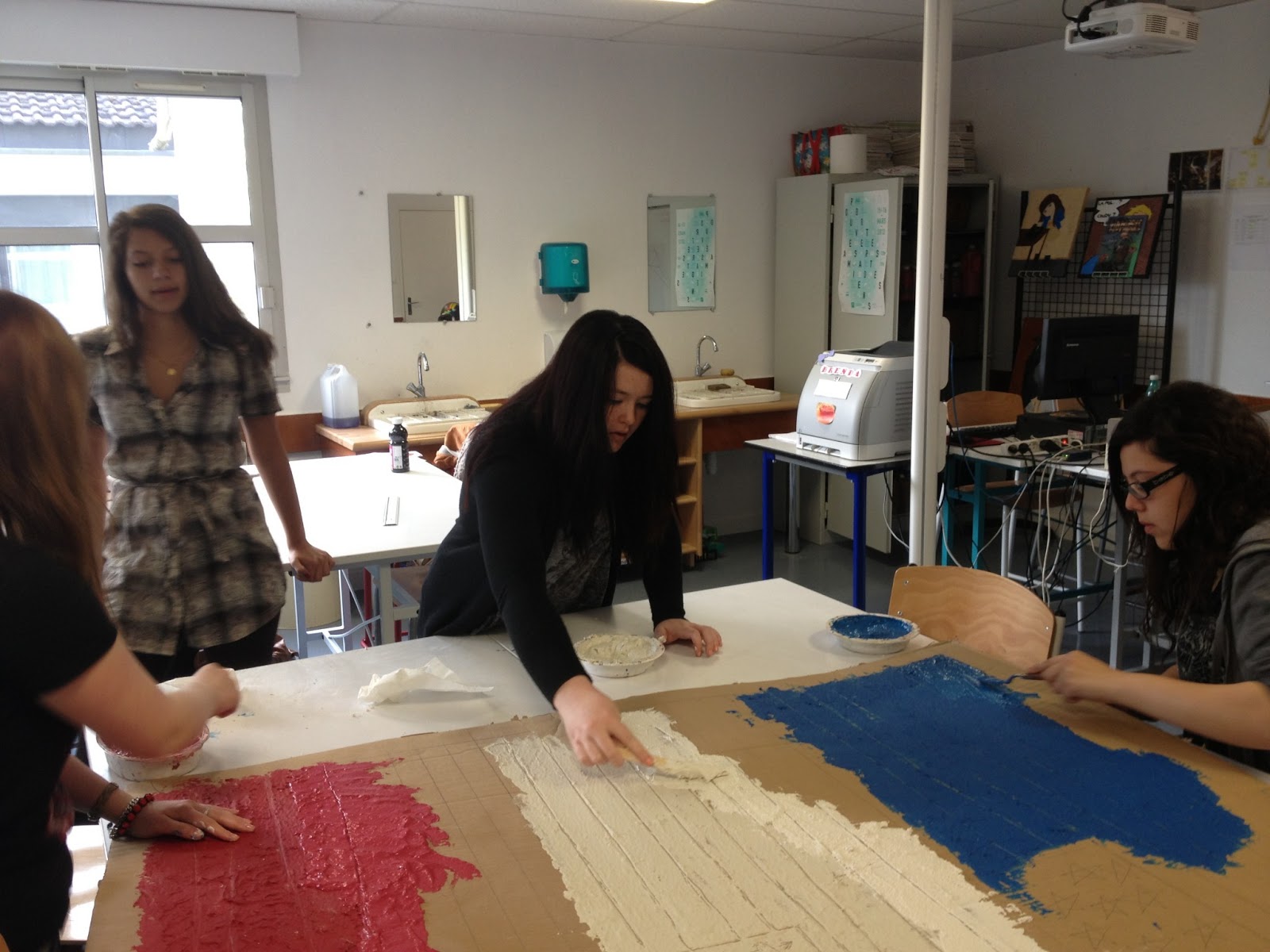
Since they only have school for a half day on Wednesdays here, we started the day back in the Art classroom to finish our flag projects. Caroline was not able to join us because she had a stomach flu. The atmosphere was very relaxed and yet focused --- the students have come to know each other better and there was none of the awkward confusion we had last Wednesday when they had not yet established a rapport and means of communicating clearly. 

Some of the groups started by projecting images to be traced onto their projects:
Others set right to work on the projects that had been waiting since last Wednesday.
Carly and Allison covered their hands with paint to mark their projects with their handprints:
Riley got to paint the lions which are one of the symbols of Picardy:
Madame Worster worked on completing her project:
Valeria did fine detailed work ont he Oklahoma flag's Osage war shield so it could be incoporated into her group's larger project:
Kiel and Riley worked with their partner and the Art teacher, Mickael DuFosse. Monsieur DuFosse will be visiting Westmoore in February 2014 with the students from Lycée Jean Racine. We have wonderful ideas for common art projects our students can do during the next school year.
Once Art class was over, the school day was also over. They students headed off with their French partners and their families for a day of fun and relaxing. Some went to the zoo, others went carting (mini-car racing), some went to music club. In the absence of their photos and explanations of how they spent their afternoons, we will have to learn together through the experiences of the teachers.

So, Madame Robillard and Madame Worster had their own "Teacher Field Trip" to Senlis. On our way there, we stopped at a quaint town called Pont-Sainte-Maxence which is the hometown of Madame Dangreville who is our partner teacher at Lycée Jean Racine and who has been hosting Madame Worster in her home. The church there was very nice: 
We found these heater stands behind the alter. It struck us an funny, but if you think about it, these gothic churches must get quite cold and in the absence of central heating, these heaters would be quite helpful:
Madame Robillard and Madame Worster in front of the church in Pont-Sainte-Maxence:
We then stopped in another small town called Fleurines at the small gothic-era church calles Église St. Jacques-St. Gilles. The altar in this small church was beautiful: 
Across the street from the church was the local town hall, which is so typically French that it merits a picture on this blog. 
The words engraved on the town hall provoked some discussion and speculation:
School, Mayor's Office, Asylum
It is probably not the first time the people considered the local government synonymous with the insane asylum!

Finally, we made it to Senis which is in the Picardy region, but in a different "département" (county) than Montdidier. Senlis is in the Oise and Montdidier is in the Somme.

Here is a link about the town of Senlis. Madame Robillard spent two weeks in Senlis in March 2012, so she was familiar with the area, but getting to visit it as a tourist was a completely new experience.

Senlis was once a Roman town and later it became a royal city. One of France's first kings, Hugues Capet, made it his home starting in 981 AD, In the center of town is a memorial for Hugues Capet with a copy of the king's signature on the side:
Right nearby there is a monument to the soldiers from North Africa (Tunisia, Algeria, and Morocco) who fought valiantly with the French forces in World War I. The monument used to be in Casablanca, Morocco, but after Morocco gained its independence from France in 1956, the monument was moved to Senlis where there was an important garrison of the French Army and where many of the North African soldiers had been trained and based. It is a moving monument and one that testifies to the long-standing relationship France has had with the people of North Africa. Today, France's largest minority group is North African.
We then made a quick stop at what used to be the train station in Senlis. It was destroyed by the Germans in World War I, rebuilt by the people of Senlis in the 1920's, then it was attacked by the Germans again in World War II. The people of Senlis decided that their train station would always be a target for invading enemy forces, so they decided to rebuild it but not to use it as a train station anymore. Of course, France has not been invaded since then, but by taking Senlis off the national train grid, they inadvertently protected the town from the urban sprawl from Paris. The result is a beautifully preserved and protect, mall, French town.
The sign reads: "This train station was built in 1922 on the site of the one that the Germans burned on September 2, 1914.
Here is Madame Robillard on one of the pretty medieval streets in Senlis.

When it was time for lunch, we decided to eat an authentic French meal for lunch. Lo and behold! The first French restaurant we found was in the underground, medieval wine cellar. It was very good food and the ambiance set the perfect tone for the day's visit.
After lunch, the next site to visit was the grounds of the ancient royal castle the the priory of St. Maurice. Here is Madame Worster framed by what remains of a great hall of the castle:
Here are some more of the beautiful grounds at the ancient castle and priory:
The royal chapel was built at the end of the reign of the French king Louis VI in the middle of the 12th century AD.
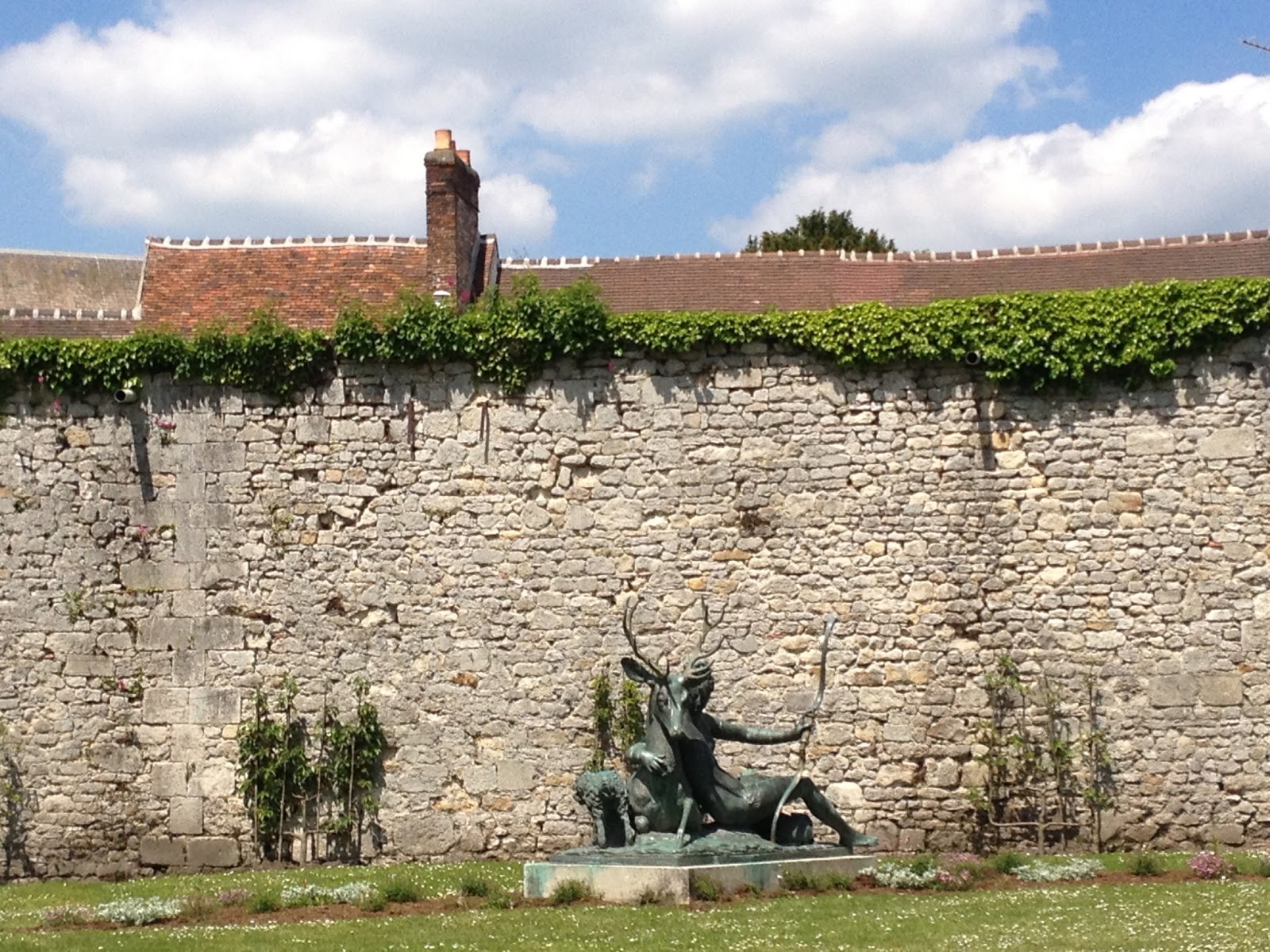
This sign in French warns people not to climb on the statute of Diana:
There was an exhibit of local artists and craftspeople in the old chapel. One of the most intriguing artists was the lace maker. She demonstrated the process for making the Bayeux lace by hand. How fortunate to see her do her work as we will be staying in Bayeux for three days next week!


More images of the beautiful grounds of the ancient royal palace and the priory of St. Maurice:
This sign has a beautiful quote by Madame Robillard's favorite poet, Jacques Prévert. Roughly translated, it says: "The true gardener discovers himself when faced with a wild thought." (But honestly, the French meaning is so much more deep, meaningful, and hard to convey in English.)

At one end of the park that is part of the ancient castle grounds, there is a museum dedicated to the Spahis --- the French light cavalry regiments made up of North African soldiers and French officiers. The following pictures are from that museum:
The next stop on the Teacher Field Trip was the beautiful Senlis cathedral which was built between 1153 and 1191 AD. Statues are sometimes missing from their spot in the architecture because they were destroyed during the French Revolution which was a revolt of the people against the nobility bus also against the Roman Catholic church which protected and justified the nobility. Notice the beautiful and very old example of graffiti on the wall inside the cathedral:
These are scenes from the interior of the cathedral:
This stained glass window is of particular note. It shows the life of Saint Louis who was also a king of France. He is the saint for which St. Louis, Missouri is named. The story begins on the bottom right and moves from right to left and upward: 1)The education of St. Louis in Cornelles, 2) St. Louis defeats the English in Taillebourg, 3) He renders justice in Vincennes, 4) He ia an arbiter between other kings, 5) He debarks in Damiette, 6) He is captured in Egypt, 7) He decides to start a new Crusade, 8) He dies in Tunis, 9) He is received into heaven by Jesus, Mary, and the saints of France:
A memorial inside the cathedral for the soldiers of Great Britain and the United Kingdom who died during the Great War in France:
A memorial inside the cathedral for the 500 commemoration of Joan of Arc's defeat of the English on the fields outside of Senlis and her later visit to the town of Senlis:
The final site on the Teacher Field Trip was the town museum of art and antiquities. There were many archaeological digs in the town of Senlis in the 1990's and the museum itself goes underground to reveal the archaeological vestiges of the Roman town that used to be Senlis (called Augustomagus by the Romans) and the many Roman artifacts they have found there. There are also many artifacts from the early Middle Ages. 

A view of the cathedral seen from the museum:
Madame Robillard's greatest joy of the day was the realization that the museum houses the works of Séraphine, an amazing primitive painter from the end of the 19th century. Her personal story was the subject of a film that won many awards. Her work is absolutely beautiful and even more so in person. Séraphine lived in Senlis so her works are collected at the museum here.